''First learn to write as if you were already dead,'' Mr. Tucci once wrote in a piece of advice to young writers, ''and then you will discover that you can write as if you were still alive.''
From the New York Times obituary on Niccolo Tucci.
Tuesday, March 11, 2008


Wow!
How cool is this! A description of archives at Harvard's Hougton library for New Directions books...manuscripts and galleys with the authors' corrections.
Sunday, March 9, 2008
Notable Book Designs
I want to tip my hat off to some of my favorite book designers. One of these days, it could well be that we will all be reading books on the internet and the days of glorious book design will have passed away (by the way, perhaps someone like Henry James might consider such days already passed...in Princess Casamassima, he talks about the beauty of elaborate bookbinding which are no longer with us).
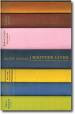
One of my favorite designs this year was the light pink and foil script/calligraphy cover of Neruda's Love Poems by Rodrigo Corral. He's also the designer for that eye-candy embellishing Javier Maria's Written Lives.
And, of course, there's Seth's moody tones for the Peanuts, helping us adults feel ever so chic while reveling in our childhood memories. But more importantly, the colors highlight the gloominess and solitude of childhood, particularly the childhood of Charlie Brown.
The Maakies are designed by the famous Chip Kidd with wonderfully chosen illustrations for the covers and elaborate endpapers.
And to round off this entry on book design, I must revere the amazing Alvin Lustig whose covers set a tone that correlated to the book with a minimal flair while being intellectually true to the book.
Wittgenstein, Silence passage correction
It took a little bit of finding the right words for a google search and using the goggle translator for each word...but it does clarify that Wittgenstein passage.
In regards to silence, Wittgenstein writes:
darüber muß man schweigen
This literally means "more [therefore, moreover] one must be silent."
The "pass over" is a nice literary embellishment, but for someone who doesn't read German and tries to reflect on every single nuance of each word (what can I say: overtraining in lit crit classes), such embellishments can hinder the understanding of the passage.
Besides the "one must be silent", one should note the passage before it as composing a polar opposite. So to put it in a visually helpful way:
what can be said at all can be said clearly
therefore one must be silent
There's a nested logic movement in the first portion:
If it can be said, it can be said clearly.
Here, I feel that Wittgenstein is laying almost an imperative to speak clearly (I can almost hear an English professor beseeching me to speak more clearly).
But if it cannot be said (and if it cannot be said, it clearly can't be said clearly), then the only option is to be silent.
As Tractatus Logico-Philosophicus concerns itself with logic, it seems to be aligning logic with what can be said clearly. What is interesting is how much he leaves as being outside the realm of logic and the realm of language. Over and over in Culture and Value, he speaks about the limits of language.
I just found out that John Koethe, the poet, has written a book on Wittgenstein. To a good extent, this helps me to understand the questions that are propelling his poems.
Historical fiction
Recently I went with a friend to see the Other Boleyn Girl with the all-star cast of Scarlett Johannsen, Natalie Portman, and Eric Bana. I was tired after a long week of too much work and wanted something relaxing and trivial. Well, the Other Boleyn Girl can be said to be trivial but it certainly was not relaxing.
After the movie, which portrays the Boleyn family as one driven by court ambitions and little else with Mary Boleyn being a saint while Ann is a scheming wench who betrays her sister for to become the queen, my friend and I discussed whether the movie bore any resemblance to history. After coming back home, I looked up Ann Boleyn on wikipedia and the wikipedia entry certainly makes the movie seem quite false. According to the wiki entry, the Boleyn family was a distinguished family with both Mary and Ann being quite sophisticated ladies of the court. Mary was known for having several distinguished lovers in her lifetime but finally opposed her family by marrying a commoner (it is generally accepted that she married for love as there was no financial or power gain for her in the marriage). And while the movie portrays the father of the Boleyn family as being weak and unable to provide for his family, the wiki entry says that he was a distinguished diplomat who sent his children abroad for the most sophisticated education available.
I looked up Phillipa Gregory's book on Amazon to see if the movie bore any resemblance to the book, and it seems that the book bears slightly more resemblance to the truth even though it emphasizes the rivalry between the sisters and also posits Ann as an ambitious wench.
Books and movies that distort historical figures have long troubled me. There are well written books that stick to the truth of a historical figure even while examining the life of that figure and giving their interpretation of that life. One such notable instance is Colm Toibin's The Master, a novel about Henry James life. The tremendous time-period novels by writers such as Peter Carey or Kazuo Ishiguro are also feats in creating realistic characters within certain time periods. Another way to use a historical basis for one's own writing is to display one's hand continually as to the literary endeavor, that it isn't history itself. This is what Anne Carson and Roberto Bolano do.
However, to write a book that is patently not true and to not acknowledge the many liberalties taken is to deceive the reader. Moreover, often it is to offer scandal in lieu of a more nuanced truth. I was horrified when I read about Geraldine Brook's March based on Bronson Alcott's life.
Let me disclose fully, at this point, that I haven't read Phillipa Gregory's Other Boleyn Girl nor Gerladine Brook's March. I've thought about doing so in order that I could think more coherently about this, but whenever I read the pages available in Amazon, I feel as though I don't need to waste time reading such books when there are so many books that are very brilliant and which I still haven't read.
I suppose I am writing about the plots as disclosed in reviews and other summaries provided by the publisher. At one point, I had to sell some historical fiction as part of my job. And mostly I found them somewhat embarrassing. It's as though these writers do not trust the readers with the more complicated truths, or that they themselves are incapable of dealing with the variables of truths and writing about it in an interesting way. Instead, the truth is distorted for the sake of a quick read, a good sell. In the end, such books will be relegated to the dustbins except for being a footnote or two in literary history.
Saturday, March 8, 2008
Absurdities abound
I am taking a break from Wittgenstein to finish reading Roberto Bolano's Nazi Literature in the Americas and the new Maakies. While vastly different in genre, there is a satirical absurd tone which joins the two.
Oh, and I spent a ridiculous amount of time this week goofing off on this website to create your very own super hero!
http://www.ugo.com/channels/comics/...eroMachine2.asp
Oh, and I spent a ridiculous amount of time this week goofing off on this website to create your very own super hero!
http://www.ugo.com/channels
Saturday, March 1, 2008
Moleskin journals
I am a big fan of Moleskin journals for numerous reasons. One, they come in various sizes and formats (blank, ruled, grid). Second, that nifty little pocket in the back is perfect for keeping miscellaneous scraps of paper with jottings. And lastly, that elastic band keeps the larger scraps of place nicely tucked in the journal.
I enjoyed this little Moleskin display of journals of various artists and writers who use the journal:
http://images.google.com/imgres?imgurl=http://www.moleskine.it/eng/_interni/city/_img/artisti/Javier_Marias.jpg&imgrefurl=http://www.moleskine.it/eng/_interni/city/exhibition.htm&h=197&w=260&sz=24&hl=en&start=17&um=1&tbnid=HKsIqgpVFPMLpM:&tbnh=85&tbnw=112&prev=/images%3Fq%3Dwritten%2Blives%2Bjavier%2Bmarias%26um%3D1%26hl%3Den%26sa%3DN
Subscribe to:
Posts (Atom)