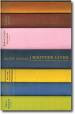
I could tell you about Maupassant, or I could tell you that this company makes me want to spend the most ridiculous sum of money on Scottish terrier barrettes with Swarovski crystals.
I will talk about Maupassant later. I am too busy window-shopping on the internet.
Friday, June 13, 2008


Thursday, June 12, 2008
Borders, swan song?
Speculations have been flying for the last year or so as to what would happen to Borders, whether they would be able to survive financially or be forced to sell themselves off.
Unfortunately, it looks like they might have to sell themselves off.
One potential buyer is, of course, Barnes and Noble. However, Border's major stockholder, William Ackerman of Pershing, is saying that Borders should approach Amazon for a buyout.
People are always surprised when I defend Borders. Many people consider Borders to be the same as Barnes and Noble. It's only within the last five years that Borders became very similar to Barnes and Noble in look as well as books chosen for their shelves; this was part of a decision to purposefully encroach on Barnes and Noble marketshare. It backfired for Borders with Borders losing their original customer base which was more sort of a young male geeky crowd (what does it say about me that I find myself more part of that demographic than others?).
I've always loved Borders' depth and range in Ancient Greek history and literature. Outside of a university store and online stores, they were the most reliable bookstore for this category. Additionally, their store on Park Avenue had an unusually large poetry section (had, I say, as that store is slated to be closed down). Also, they carried university press titles that Barnes and Nobles did not carry in the 90s. I remember going to a Barnes and Noble store in 1998 and trying to special order a university press title and being told that it was a service they didn't provide.
It will be interesting to see what happens to Borders. They were once a fascinating company, and the vestiges of their unique culture still remain in the older stores with deep backlist representation and wide variety of titles. I've bought Korean cookbooks there that are not available in other brick and mortar stores, philosophy titles, and many volumes of poetry in the Park Avenue store. In some ways, their stores complemented the independent bookstores as Borders often had large sections of categories that many independent bookstores do not. And of course, in other ways, Borders was another direct competitor to the independent bookstores in the categories that most trade bookstores cover (fiction, history, current affairs). It's a shame that Borders lost that commitment to books and decided to pursue greater profits in a change of mission that might cost them everything.
Unfortunately, it looks like they might have to sell themselves off.
One potential buyer is, of course, Barnes and Noble. However, Border's major stockholder, William Ackerman of Pershing, is saying that Borders should approach Amazon for a buyout.
People are always surprised when I defend Borders. Many people consider Borders to be the same as Barnes and Noble. It's only within the last five years that Borders became very similar to Barnes and Noble in look as well as books chosen for their shelves; this was part of a decision to purposefully encroach on Barnes and Noble marketshare. It backfired for Borders with Borders losing their original customer base which was more sort of a young male geeky crowd (what does it say about me that I find myself more part of that demographic than others?).
I've always loved Borders' depth and range in Ancient Greek history and literature. Outside of a university store and online stores, they were the most reliable bookstore for this category. Additionally, their store on Park Avenue had an unusually large poetry section (had, I say, as that store is slated to be closed down). Also, they carried university press titles that Barnes and Nobles did not carry in the 90s. I remember going to a Barnes and Noble store in 1998 and trying to special order a university press title and being told that it was a service they didn't provide.
It will be interesting to see what happens to Borders. They were once a fascinating company, and the vestiges of their unique culture still remain in the older stores with deep backlist representation and wide variety of titles. I've bought Korean cookbooks there that are not available in other brick and mortar stores, philosophy titles, and many volumes of poetry in the Park Avenue store. In some ways, their stores complemented the independent bookstores as Borders often had large sections of categories that many independent bookstores do not. And of course, in other ways, Borders was another direct competitor to the independent bookstores in the categories that most trade bookstores cover (fiction, history, current affairs). It's a shame that Borders lost that commitment to books and decided to pursue greater profits in a change of mission that might cost them everything.
non sequitur
Because sometimes you need to take a break from reading to save bunnies:
Cure The Bunny

Click here to play this game
I think bunny is happier in heaven.
And then I decided a longer break was needed, visited Bully's website and stole this:
Alright, alright, I am actually going to read.
Cure The Bunny
Click here to play this game
I think bunny is happier in heaven.
And then I decided a longer break was needed, visited Bully's website and stole this:
Alright, alright, I am actually going to read.
Saturday, June 7, 2008
Bully says...
"Your bow is not broken but you've run out of arrows. How can you fake being a bard?
It might be better to switch to being a poet. After all, things can go from bard to verse."
While I've always delighted in Bully Says Comics Oughta Be Fun, this was the first time I checked out his profile page. The quote above is what I found as part of his profile...a punning bull is one after one my own punning heart.
For those who read comics and graphic novels, make sure to check out Bully's blog. One of my favorite things is to look at the Ten of a Kind feature which matches comic book covers with the same theme.
It might be better to switch to being a poet. After all, things can go from bard to verse."
While I've always delighted in Bully Says Comics Oughta Be Fun, this was the first time I checked out his profile page. The quote above is what I found as part of his profile...a punning bull is one after one my own punning heart.
For those who read comics and graphic novels, make sure to check out Bully's blog. One of my favorite things is to look at the Ten of a Kind feature which matches comic book covers with the same theme.
Tuesday, June 3, 2008
Will Work for Books
What's one thing that anyone in the book industry needs (besides books, that is): tote bags!!
And BEA is the best place to get many different kinds of tote bags specifically made to carry many many books. Sadly, I was pretty much chained to a booth to a whole time and could not roam around the floor to pick up one tote bag after another. The best tote bag I saw going around said: Will Work for Books (I think that's a wry shot at the book industry salaries).
While I did not get a chance to pick up many tote bags (although I did make one very quick trip to the Oxford University booth to pick up an Oxford English Dictionary tote bag. I must express my inner-geekiness!) I had many wonderful conversations with all sorts of industry people from those in publishing to bookstore people as well as some book reviewers.
Books are one reason to be in the book industry. The other reason are the people. Some of the smartest, nicest, and most interesting people are in the book industry (and I am lucky enough to know the best ones!). Plus, I am convinced that this industry is the one with the best conversations. I am all about the conversation.
And BEA is the best place to get many different kinds of tote bags specifically made to carry many many books. Sadly, I was pretty much chained to a booth to a whole time and could not roam around the floor to pick up one tote bag after another. The best tote bag I saw going around said: Will Work for Books (I think that's a wry shot at the book industry salaries).
While I did not get a chance to pick up many tote bags (although I did make one very quick trip to the Oxford University booth to pick up an Oxford English Dictionary tote bag. I must express my inner-geekiness!) I had many wonderful conversations with all sorts of industry people from those in publishing to bookstore people as well as some book reviewers.
Books are one reason to be in the book industry. The other reason are the people. Some of the smartest, nicest, and most interesting people are in the book industry (and I am lucky enough to know the best ones!). Plus, I am convinced that this industry is the one with the best conversations. I am all about the conversation.
Monday, May 19, 2008
Paper writing
When I was in college, and then grad school, the most stressful, as well as most useful, periods were the paper times. They were usually due the week of midterms and finals. My strategy was generally to wait until the last minute possible to write the paper although I read and researched early on and up until the last minute. Then, I would pull an all-nighter with one page per one hour. The long papers, those that were 20 pages or over in length, required at least a couple of nights.
What does it say about my geekiness that I miss paper writing? I have neither the time nor the leisure to research a novel thoroughly now. The paper writing process forced me, as a student, to try to coalesce impressions, thoughts, ideas about a book, a writer, and the time period. I've done a few reviews but I don't find it as satisfying. There's the length limitation as well as the fact that book reviews, if they are to be published in most formats, are generally about contemporary writers.
Right now, I am not thinking much about specific contemporary writers. My head is floating amidst canonical writers such as Henry James, Shakespeare, Proust, the Ancient Greeks, and some philosophers. Most of all, I would like to write about Henry James, to think about Henry James in writing about him and his books. I am reminded again of Colm Toibin's tremendous novel about James. James' genius of writing, but even more importantly, his understanding of human beings are unparalleled. There is the important French influence: Flaubert, Balzac, Maupaussant. As with the French Naturalists, James is not sentimental. However, there is a generosity.
It's something to think about, that generosity and how that is different than sentimentality.
What does it say about my geekiness that I miss paper writing? I have neither the time nor the leisure to research a novel thoroughly now. The paper writing process forced me, as a student, to try to coalesce impressions, thoughts, ideas about a book, a writer, and the time period. I've done a few reviews but I don't find it as satisfying. There's the length limitation as well as the fact that book reviews, if they are to be published in most formats, are generally about contemporary writers.
Right now, I am not thinking much about specific contemporary writers. My head is floating amidst canonical writers such as Henry James, Shakespeare, Proust, the Ancient Greeks, and some philosophers. Most of all, I would like to write about Henry James, to think about Henry James in writing about him and his books. I am reminded again of Colm Toibin's tremendous novel about James. James' genius of writing, but even more importantly, his understanding of human beings are unparalleled. There is the important French influence: Flaubert, Balzac, Maupaussant. As with the French Naturalists, James is not sentimental. However, there is a generosity.
It's something to think about, that generosity and how that is different than sentimentality.
Friday, May 16, 2008
Proust
I started reading Swann's Way in the translation by Lydia Davis a couple of months ago, and am meandering very slowly through it. Part of the reason for my slowness is because there is only one volume that is translated by Davis, and I fear that the other volumes will be...not necessarily inferior, but just different in tone. And so far, I am enjoying her translation very much.
I am now in the section dealing explicitly with Swann, and I feel rather bereft at leaving Combray behind. Even though the pace picks up in the portion dealing with Swann's love life, the slow and meditative texture of Combray, that feeling of Proust shifting through every little piece of memory, is not as present in the Swann in Love section. Even though the movement through the Combray section seems natural enough, in retrospect, one marvels at the amount of art and precision that went into weaving memories and intersecting lives through two different walking paths through Combray.
I was particularly moved by the story of the bourgeois piano teacher whose greatest pride was his daughter only to pretend that she wasn't holding lesbian intrigues, what was then considered a moral failing, and even more moved by the daughter trying to believe in her depraved nature as she recognized the grief she had brought to her father. It points to one of Proust's greatnesses, his gentleness in pinpointing a person's foibles, the sexual failings that are so human in each of us. While the piano teacher's daughter has a specific failing relating to gender orientation, yet, in the nature of desire, passion, and a very specifically sexual desire, her failure is part of a larger tapestry of human flaws that are revealed in the way each character construes their sexual desire for the other, the one.
I am now in the section dealing explicitly with Swann, and I feel rather bereft at leaving Combray behind. Even though the pace picks up in the portion dealing with Swann's love life, the slow and meditative texture of Combray, that feeling of Proust shifting through every little piece of memory, is not as present in the Swann in Love section. Even though the movement through the Combray section seems natural enough, in retrospect, one marvels at the amount of art and precision that went into weaving memories and intersecting lives through two different walking paths through Combray.
I was particularly moved by the story of the bourgeois piano teacher whose greatest pride was his daughter only to pretend that she wasn't holding lesbian intrigues, what was then considered a moral failing, and even more moved by the daughter trying to believe in her depraved nature as she recognized the grief she had brought to her father. It points to one of Proust's greatnesses, his gentleness in pinpointing a person's foibles, the sexual failings that are so human in each of us. While the piano teacher's daughter has a specific failing relating to gender orientation, yet, in the nature of desire, passion, and a very specifically sexual desire, her failure is part of a larger tapestry of human flaws that are revealed in the way each character construes their sexual desire for the other, the one.
Subscribe to:
Posts (Atom)